Guaranteed acceptance or your money backDispatched the same working dayAccepted by HM Passport Office, DVLA & HMRC

Drafted by paralegals since 2000

Our Deed Poll, in plain English

Deed Poll wording explained

The wording on a Deed Poll does three jobs: it declares that the paper is a deed, it records that you have given up your old name and taken a new one for every purpose, and it asks everyone to use the new one. “Renounce, relinquish and abandon” means giving the old name up completely. “Executed as a deed” means signed in front of a witness and delivered, and it is that signing, rather than any one approved form of words, that gives a deed its force.

  • Quoted from our real deed
  • Each phrase, in plain English
  • Checked against legislation.gov.uk
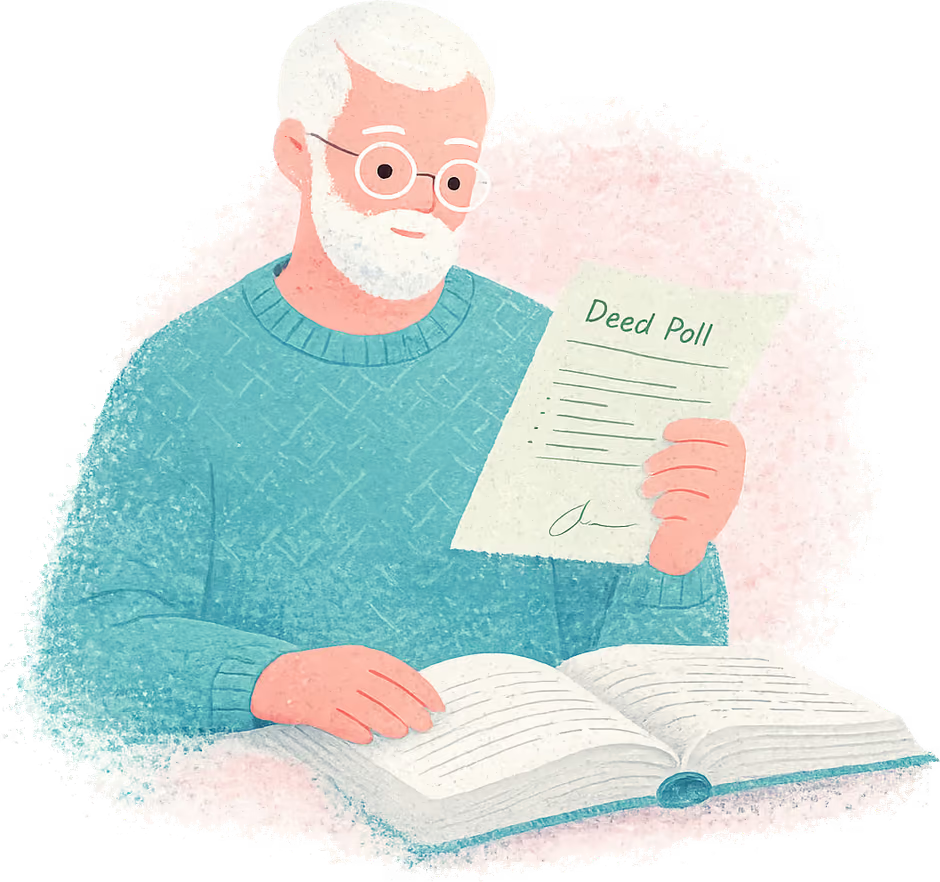
An older man with a white beard and round glasses in a teal jumper, holding a Deed Poll in one hand and resting the other on a thick open dictionary

What the wording does

  1. Says it is a deed“Change of Name Deed”, “By this Deed”, “Signed and Delivered”
  2. Swaps the names, for goodThe old one given up, the new one taken “from today”
  3. Tells everyone elseA request to all persons to use the new name
Phrase by phrase

Every phrase on our Deed Poll, and why it is there

The drawing marks where each phrase sits on our adult deed, with the rest of the wording shown as lines. The numbers match the list. We quote phrases, not the deed in full: yours is drafted around your own names and details.

1Change of Name Deed 1By this Deed 2the undersigned 3now lately 4a Citizen … by birth 5renounce, relinquish and abandon 6assume from today 7called, known and distinguished 8For the purpose of evidencing 9as well private as public 10in substitution for 11designate and address 12In Witness __ / __ / __ 13Signed and Delivered 14As a Deed by 14Formerly
Our adult Deed Poll, with the fourteen phrases explained here marked in order.
  1. “Change of Name Deed” and “By this Deed”

    Means: the paper is a deed, and the change of name is made by it.

    Why it is there: under the Law of Property (Miscellaneous Provisions) Act 1989, a document is not a deed unless it makes clear on its face that it is meant to be one, for instance by describing itself as a deed. Our heading does that, and the opening words repeat it.

  2. “I the undersigned … do hereby”

    Means: “I, the person signing below, by this document do the following.”

    Why it is there: it ties the person named at the top to the signatures further down, and “do hereby” opens the three numbered declarations. When both parents sign a child’s deed, it becomes “We the undersigned”, followed by each of their names.

  3. “now lately”

    Means: old-fashioned English for “now, and recently”: the person just named in the old name has lately taken the new one. A child’s deed spells it out as “now lately called”.

    Why it is there: it sets the old name, your address and the new name side by side in the very first sentence, so the deed links the two names before it says anything else.

  4. “a Citizen of the United Kingdom and Colonies by birth”, or “a Resident of …”

    Means: a description of you, set by your answer at the checkout to whether you were born in the United Kingdom. Born here, it says citizen by birth; born elsewhere, it says resident.

    Why it is there: it is part of the traditional wording that introduces the person making the deed. It describes rather than decides: more on the nationality line.

  5. “wholly renounce, relinquish and abandon”

    Means: you give the old name up completely. To renounce is to give it up formally, to relinquish is to let go of any hold on it, and to abandon is to stop using it altogether. The clause begins “For and on behalf of myself”; on a child’s deed the parents say it on the child’s behalf.

    Why it is there: it is the first half of the change. GOV.UK’s model wording puts the same idea in four plain words, “have given up my name”; three verbs in a row leave no part of the old name held back.

  6. “assume from today the name of”

    Means: take on the new name, starting on the day you sign.

    Why it is there: it is the second half of the change, the one GOV.UK words as “have adopted for all purposes”. “From today” points to the date you write in the closing line, which is why that date must be the day of signing.

  7. “called, known and distinguished”

    Means: called is what people say to you, known is the name you go by, and distinguished is the name that tells you apart from everyone else, the way a record does.

    Why it is there: it names each way a name gets used, so the new one replaces the old in every one of them.

  8. “For the purpose of evidencing such my determination”

    Means: “to give evidence of this decision of mine”.

    Why it is there: it says what the deed is for. In law your name is the one you are generally known by, and the deed is the proof of a change: the note to the Enrolment of Deeds (Change of Name) Regulations 1994 describes changing a surname by Deed Poll as “only evidential and formal”.

  9. “as well private as public”

    Means: in private dealings and public ones alike. Around it, “in all records, deeds and writing” and “upon all occasions whatsoever” make the same point: every document, every occasion, no exceptions.

    Why it is there: it commits you to using the new name everywhere, which is what record holders look for. HM Passport Office, for one, asks for evidence that you use a new name “for all official purposes”.

  10. “in place and in substitution for”

    Means: instead of. Both halves say that the new name takes the old one’s place.

    Why it is there: it closes the second declaration by naming the old name once more, as the one being replaced, so each declaration states both names.

  11. “expressly authorise and request … designate and address”

    Means: you plainly give everyone permission, and ask them, to name you in their records (designate) and to speak and write to you (address) by the new name.

    Why it is there: it turns the change outwards. The first two declarations are about what you do; the third speaks to everyone else.

  12. “In Witness” and “former and adopted names”

    Means: “In Witness” is old legal English for “as evidence of this”. The line records that you have signed with your former and adopted names, your old and new ones, and leaves the date blank.

    Why it is there: it carries the date you sign. Despite the word, it is not where your witnesses sign: their spaces are at the foot of the page. Where everything is signed.

  13. “Signed and Delivered”

    Means: signed, and delivered as a deed. Delivery has nothing to do with the post: HM Land Registry’s guide to executing deeds describes it as showing, by words or conduct, an intention to be bound.

    Why it is there: section 1(3) of the 1989 Act sets two tests for a deed made by an individual: a signature made while a witness looks on, which that witness then attests, and delivery as a deed. These words say both happened. Why no stamp or seal is needed.

  14. “As a Deed by” and “Formerly”

    Means: the box beside “As a Deed by” takes your signature as a deed in your new name, printed beneath it. “Formerly” means previously, and its box takes your signature in the name you used before.

    Why it is there: HM Passport Office accepts an unenrolled deed when it is signed in both the old and the new name, and the two boxes make sure both are there. A child’s deed has a box for each parent who signs, the first beside “As a Deed by the above named”.

Two things people ask

Capital letters, titles and the nationality line

Why the names are in capitals, with a title

Every name on our deed, and your address, is printed in capital letters, with the title you chose at the checkout in front of each name. Capitals set the names apart from the wording around them, so each is easy to find and to check letter by letter before anyone signs.

Printing in capitals is layout, not a change: GOV.UK says a Deed Poll cannot be used to change which letters of a name are capitals. Nor can it change a title, so the deed shows the title you use, and a new one is something you tell each organisation yourself.

The nationality line

The opening describes you either as “a Citizen of the United Kingdom and Colonies by birth” or as “a Resident of the United Kingdom and Colonies”, depending on whether you told the checkout you were born in the United Kingdom. Both are equally valid.

The phrase is part of the traditional wording. Citizenship of the United Kingdom and Colonies is the status that the British Nationality Act 1981 replaced, when those who held it with the right of abode became British citizens. On a Deed Poll it describes you and decides nothing: the deed changes your name alone, and HM Passport Office’s checklist for accepting one does not look at this line.

Child and replacement deeds

The phrases that change on our other deeds

The heading, the three declarations and the closing words stay. These are the lines that differ.

The phraseOn which deedWhat it means
“mother and father with parental responsibility with regards to”A child’s, both parents namedThe parents who hold parental responsibility for the child. GOV.UK counts choosing a child’s name, and consenting to a new one, among the responsibilities it carries. With one parent, it reads “mother” or “father” alone.
“a minor”A child’sSomeone under 18. Since the Family Law Reform Act 1969, full age comes at 18, and a deed that says “minor” means someone younger. Ours is for children under 16; at 16 or 17 you sign the adult deed.
“For and on behalf of our child”A child’sThe parents make the declarations for the child, who does not sign. With one parent it reads “my child”.
“As a Deed by the above named”A child’sThe parent or parents named in the opening sign here, each in a box of their own.
“confirm that I executed a change of name deed on or about”An adult replacementExecuted means made as a deed: signed, witnessed and delivered. “On or about” lets you give the original date as nearly as you know it.
“and that deed is lost”An adult replacementWhy a replacement exists. The declarations that follow record the same change again.
“originally changed via Deed Poll on the following date”A child’s replacementA fourth numbered line with the date of the child’s first deed, and that it is lost.

From our deed generator, in every version. Our replacement service and our child Deed Poll explain who orders each.

Set wording or not

Does a Deed Poll have to use these words?

No. HM Passport Office’s caseworker guidance gives an unenrolled deed “no set format or wording”. What it checks is the signing: both names, at least one witness, wet ink and a date.

The ideaOurs, traditionalGOV.UK’s model, plain
It is a deed“Change of Name Deed”, “Signed and Delivered”“Name change deed”, “Signed as a deed”
The old name goes“renounce, relinquish and abandon”“have given up my name”
The new name comes“assume from today”“have adopted for all purposes”
Everyone may use it“designate and address”No separate line
Lines of GOV.UK’s ownNot includedTelling the police, which applies only to registered offenders; and that authorities may check both names

Under the 1989 Act a deed needs three things whatever its wording: it must say it is a deed, its signature must be made with a witness present who then attests it, and it must be delivered. The police line concerns a duty that applies whatever a deed says: GOV.UK tells registered offenders to tell the police within 3 days of changing their name. Neither of GOV.UK’s extra lines is on HM Passport Office’s list of what a deed must show.

If you would rather write your own, the Deed Polls Online handbook, our sister site, lists the parts every Deed Poll must have. Ours keeps the traditional phrasing, is drafted by a paralegal and checked by quality control before printing, and is guaranteed to be accepted, or your money back.

Questions & answers

Deed Poll wording, answered

What does “renounce, relinquish and abandon” mean on a Deed Poll?

That you give up your old name completely. To renounce a name is to give it up formally, to relinquish it is to let go of any hold on it, and to abandon it is to stop using it. GOV.UK’s own model wording says the same in plainer words, “have given up my name”. The phrase in context.

What does “executed as a deed poll” mean?

That the document was made as a deed by one person: signed while a witness was present, attested by that witness, and delivered, the test in section 1 of the Law of Property (Miscellaneous Provisions) Act 1989 for a deed made by an individual. “Poll” marks a deed made by one person alone, which is why nobody but you and your witnesses signs it. Our replacement deed uses the word when it confirms that an earlier deed was “executed”.

Why is my name in capital letters on my Deed Poll?

So that every name, and your address, stands apart from the wording and is easy to check letter by letter. It is a matter of layout and changes nothing: GOV.UK says a Deed Poll cannot be used to change which letters of a name are capitals. The title printed in front of each name is the one you chose at the checkout. Capitals and titles.

Why does my Deed Poll say “Citizen of the United Kingdom and Colonies”?

Because you told the checkout you were born in the United Kingdom; born elsewhere, the deed says “a Resident of the United Kingdom and Colonies” instead, and both are equally valid. The phrase belongs to the traditional wording and describes you. It does not change or decide your nationality, and HM Passport Office’s checklist for accepting a deed does not look at it. The nationality line.

Does a Deed Poll have to use this exact wording?

No. HM Passport Office’s caseworker guidance says an unenrolled deed has “no set format or wording”, and looks instead for signatures in both names, a witness, wet ink and a date. The law asks only that a deed says it is one, carries a signature made with a witness present who then attests it, and is delivered. Ours uses the traditional wording and is guaranteed to be accepted.

What does “In Witness” mean on a Deed Poll?

“As evidence of this”. It opens the closing line, which records that you have signed with your old and new names and holds the date you sign. It is not where your witnesses sign: on ours their spaces are the ruled lines at the foot of the page. Where to sign your Deed Poll.

Something else? Ask a paralegal and we will answer, usually the same working day.

Traditional wording, drafted for you

Apply online in about five minutes. A paralegal drafts your Deed Poll in this wording, quality control checks every name, and it is posted the same working day, guaranteed to be accepted.

Secure checkout · card, PayPal, Apple Pay, Google Pay and Klarna