Guaranteed acceptance or your money backDispatched the same working dayAccepted by HM Passport Office, DVLA & HMRC

Drafted by paralegals since 2000

Your licence and your gender

How do I change the gender on my driving licence?

Post DVLA a form D1 with your licence and one of three originals: a Deed Poll, a statutory declaration or a Gender Recognition Certificate. GOV.UK says the change costs nothing and needs no certificate, and you can drive while the new card is made. It arrives with a different driver number, because the seventh character follows the gender on DVLA’s record.

  • From GOV.UK and a DfT answer to Parliament
  • Free, with no certificate needed
  • Checked November 2026
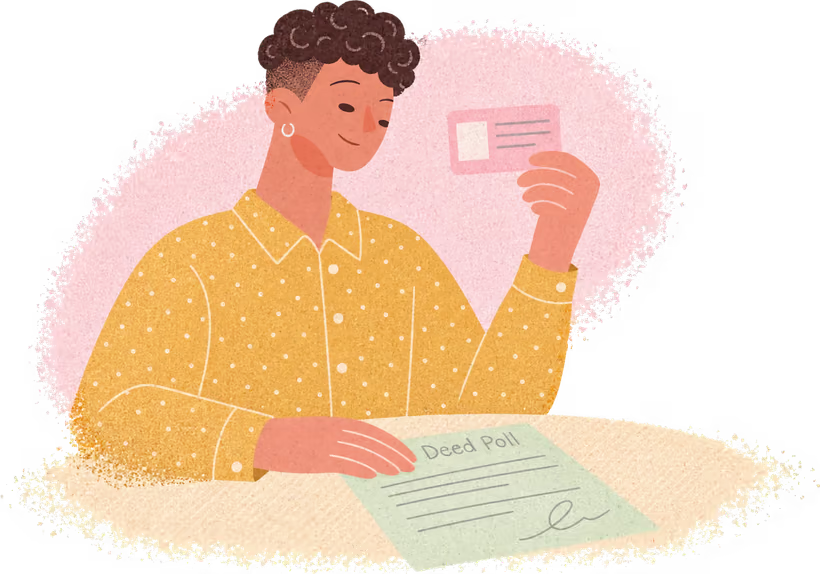
A smiling young person with short dark curls and a shaved side, a small silver hoop earring and a mustard shirt with white dots, sitting at a table holding up a pink driving licence card in one hand, the other hand resting on a pale green Deed Poll

The same envelope as a new name

GOV.UK’s guide is called “Change the name or gender on your driving licence”, and it treats both alike: form D1 from most Post Offices, your current licence and original evidence, posted to DVLA in Swansea, with no fee. For the evidence, DVLA wants at least one of three documents, and a Gender Recognition Certificate is only one of them.

What to send

What DVLA needs to change the gender on your licence

GOV.UK’s identity documents page has a list of its own for anyone whose gender identity has changed. Choose one document from it and send the original.

The three documents GOV.UK lists for a change of gender identity
EvidenceWhat it isSend with it
A Deed Poll OursA deed giving up your former name and taking a new one, signed in front of a witnessOne document in your new name, or a UK passport number
A statutory declarationAn official statement confirming the change, made before a solicitor, a magistrate or a commissioner of oathsOne document in your new name, or a UK passport number
A Gender Recognition CertificateLegal recognition of your affirmed gender, granted by the Gender Recognition PanelNothing further on GOV.UK’s list

Whichever you choose, GOV.UK also wants the identity document or driving licence that shows your previous name or gender identity, and the licence you are returning does that. The document in your new name has to be valid and issued after both the Deed Poll or declaration and your most recent licence, and a letter, bill or statement must be from the last 12 months. Documents that count.

Car or motorbike licence: form D1
DVLA
Swansea
SA99 1BN

£0for the change itself

  • Form D1From most Post Offices, filled in and signed
  • Your licenceThe photocard, or an old paper licence with a printed passport-type photo
  • One original from the listNever a photocopy, a certified copy or a laminated certificate
  • With a Deed Poll or declarationOne document showing your new name

Your originals come back on their own, by second class post. A lorry or bus licence goes on form D2 to SA99 1BR.

Only if you want them. A new photo at the same time costs £17, which drivers over 70 and holders of a medical short period licence do not pay. A lost licence can still be replaced on the same form, for £20. From GOV.UK’s name or gender guide and identity documents page, checked November 2026.

A certificate?

Do you need a Gender Recognition Certificate for your licence?

No. GOV.UK’s guide to applying for a certificate names the driving licence first among the records you can update without one. DVLA’s own list agrees, because it asks for any one of three documents, and the other two are a Deed Poll and a statutory declaration.

None of the three is a medical document, and the licence page asks for no medical report. A certificate does change other things, such as a birth certificate registered in the UK, which is a separate application with its own rules.

The Department for Transport said the same to Parliament in September 2025, in the answer quoted alongside.

GOV.UK, on the certificate

“You do not need a certificate to: update your driving licence”

The Department for Transport

Evidence “can include a deed poll, statutory declaration or a gender recognition certificate.”

The seventh character

Why your driving licence number changes with your gender

A DVLA driver number carries your date of birth, and one of its digits is written differently for a man and for a woman. Asked in 2025 how licence numbers show the holder’s sex, the Department for Transport answered:

“The seventh character of the number will be a zero or one if the driver record shows the licence holder is male, and five or six if the record shows the licence holder is female.”

Lord Hendy of Richmond Hill for the Department for Transport, HL10124, answered 12 September 2025

Record shows male

Record shows female

An invented number for Alex Jordan Lewis, born on 15 October 1987, belonging to no one. From DVLA’s leaflet INS57P and the answer above, checked November 2026.

Where the digit comes from

DVLA’s leaflet INS57P takes the number apart. After the five surname letters come six digits from your date of birth: the first and last make the year, the second and third the month, and the fourth and fifth the day. For a woman, it says, 5 is added to the first digit of the month, so October is 60 on her licence and 10 on a man’s. That first digit of the month is the seventh character of the whole number.

What moves, and what does not

So once DVLA records your new gender, that one character moves by five: 0 becomes 5, or 1 becomes 6, and back again the other way. The second digit of the month, the day and the year stay put. The answer ties the digit to what the record shows, not to the day the number was first given out, so the card DVLA sends after the change carries the new one.

What nobody says

Neither the leaflet nor the answer says whether the last three characters, the check digits DVLA’s computer generates, are changed at the same time. The number printed on your new card is the one to use from then on, for a check code, a hire car or an insurer. Who needs the new number.

Your number

See your seventh character, before and after

Choose your month of birth and what DVLA’s record shows now, or let the page read both from your driver number. It follows the leaflet’s rule and DfT’s answer, and says plainly where they stop.

Your seventh character, before and after

The seventh and eighth characters for every month of birth, on a record showing male and on one showing female:

The seventh and eighth characters of a DVLA driver number, by month of birth
Born inRecord shows maleRecord shows female
January0151
February0252
March0353
April0454
May0555
June0656
July0757
August0858
September0959
October1060
November1161
December1262

The seventh character is shown in bold. From DVLA’s leaflet INS57P (July 2025) and DfT’s answer HL10124 (12 September 2025), checked November 2026. Your new card has the final word.

Name and gender

Changing your name and gender together

One form D1 can carry both, and a Deed Poll can be the evidence for both, since it appears on GOV.UK’s list for a new name and on its list for a change of gender identity. Add one document already in your new name, such as a recent bank statement, or write the number of a UK passport that shows it.

A new surname or new first names move other characters of the number as well: the surname letters at the start, and the two initials after the date of birth. Compare your old and new names.

A title such as Mx. GOV.UK handles a new title on the same form D1, asking for proof only when the title is inherited. Which titles DVLA’s records can show is not published anywhere we have looked, and we have found no DVLA statement either way on Mx, so we cannot tell you whether it records or prints one. Our checkout offers Mx beside Mr, Mrs, Miss, Ms and Dr, or lets you type a title of your own, and your Deed Poll prints the one you choose in front of your new name, though GOV.UK’s deed poll guide is clear that a deed poll cannot itself change a title.

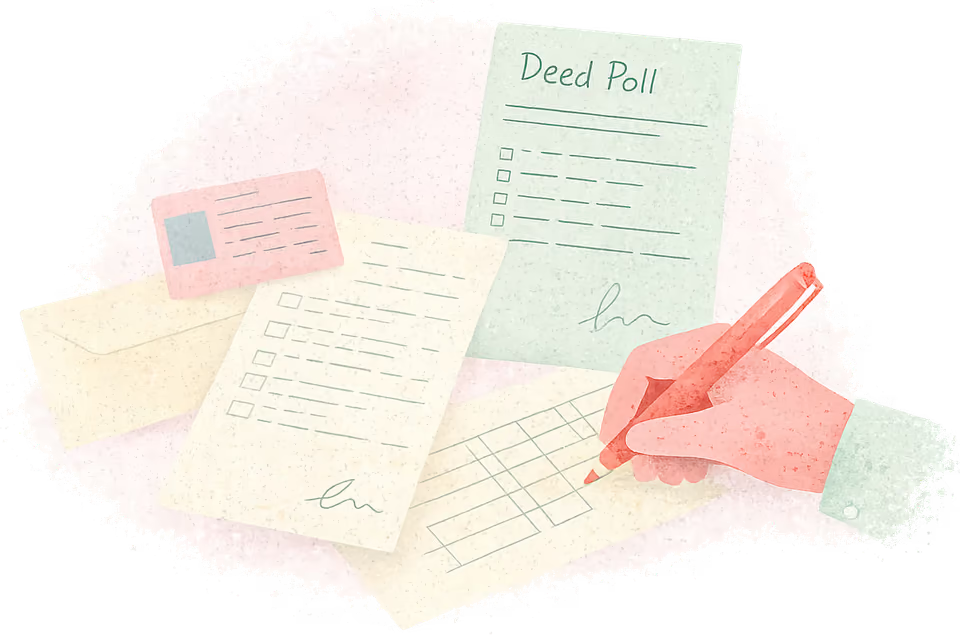
A hand with a coral pen filling in a cream form of small boxes, beside a green Deed Poll, a pink driving licence card and an envelope
Non-binary

Non-binary, and what a licence number can record

DfT’s answer gives the seventh character two patterns, one for a record that shows male and one for a record that shows female, and describes no third. GOV.UK’s certificate guide says plainly that UK law does not recognise non-binary genders.

Record shows male

The seventh character is 0 for a birthday from January to September, and 1 for October to December.

Record shows female

The same month with 5 added to its first digit: 5 from January to September, 6 from October to December.

Anything else

Not mentioned in the answer, the leaflet or GOV.UK’s licence pages. A title is a separate matter, changed on form D1 in the same way as a name.

For the wider picture, from passports to HMRC and banks, the Deed Polls Online handbook, our sister site, has a guide to changing your name and gender identity, another on what each record can show for a non-binary person, and one on applying for a Gender Recognition Certificate. A passport is applied for direct, on GOV.UK or at a Post Office.

After the licence

Your log book, your car and DVLA’s other records

Your V5C log book

A new name must go on it too, GOV.UK says, usually free, by post, with proof such as your Deed Poll, and the new log book can take up to 6 weeks. Its log book pages speak only of names and addresses: we found nothing on them about gender. Your V5C and a new name.
Your insurer and the rest

An insurer that keeps your licence number needs the new one once the card comes, and a new name in any case. Finance, breakdown cover and parking permits are on our list for your car, in the order to do them.

Check codes and your record

GOV.UK’s view or share service opens with your licence number, National Insurance number and postcode, and makes the 21-day check code a hire firm asks for. Once the new card comes, use the number printed on it. Car hire and a new licence.

Northern Ireland

A Northern Ireland licence: the DVA and form DL1

Licences issued in Northern Ireland come from the Driver & Vehicle Agency, not DVLA. nidirect’s page on proof of identity for a licence carries the same three choices for a change of gender identity, a Deed Poll, a statutory declaration or a Gender Recognition Certificate, with the document that shows your previous name or gender.

A new name cannot be reported to the DVA online, so it goes on form DL1 by post, and nidirect’s fee table prices a change of name at nothing. Neither that table nor the DL1 notes mention a change of gender. DfT’s answer is about DVLA’s numbers, too: nidirect asks for the eight characters of a DVA licence number, and does not say whether any of them records gender.

Northern Ireland: form DL1
Driver Licensing Division
County Hall
Castlerock Road
Waterside
Coleraine
BT51 3TB

Posta name never goes online

From nidirect on proof of identity, keeping a licence up to date and licence fees, and the Department for Infrastructure, checked November 2026.

Questions & answers

More about your licence and your gender

How do I change the gender on my driving licence?

Fill in form D1 from a Post Office and post it to DVLA, Swansea, SA99 1BN with your licence and one original: a Deed Poll, a statutory declaration or a Gender Recognition Certificate. With a Deed Poll or declaration, add one document in your new name. There is no fee. What to send.

Do I need a Gender Recognition Certificate to change my driving licence?

No. GOV.UK lists the driving licence among the records you can update without a certificate, and DVLA accepts a Deed Poll or a statutory declaration instead. The Department for Transport told Parliament the same in September 2025. The certificate question.

Does my driving licence number change if I change gender?

Yes, by one character. The seventh is 0 or 1 when DVLA’s record shows male and 5 or 6 when it shows female, according to DfT’s written answer HL10124, so a new recorded gender gives a new number. The rest of your date of birth stays the same. See your digit change.

Can I change my name and gender on my licence at the same time?

Yes, on one form D1. A Deed Poll is on GOV.UK’s list for both changes, so it can cover the two together, with one document in your new name. The surname letters and initials in your licence number may change as well. Name and gender together.

Can I change the gender on my driving licence online?

GOV.UK gives no online route for it. Its guide sends you to form D1 by post, the same as a new name, and its renewal service closes once your name or title has changed. What DVLA does let you do online.

Can my driving licence show Mx or a non-binary gender?

DfT’s answer describes a licence number for a record showing male or female, and nothing else, and GOV.UK states that UK law does not recognise non-binary genders. A new title goes on form D1 without evidence, but we have found no DVLA statement on whether it holds Mx. Non-binary and the licence.

Has the Supreme Court ruling changed how DVLA handles a change of gender?

Not on GOV.UK’s licence pages as we read them in November 2026, which still list a Deed Poll, a statutory declaration or a certificate. The ruling, For Women Scotland, was given on 16 April 2025 and concerned the meaning of sex in the Equality Act 2010. DfT’s answer on licence numbers came after it, on 12 September 2025.

How do I change the gender on a Northern Ireland driving licence?

Through the Driver & Vehicle Agency rather than DVLA. nidirect lists the same three documents for a change of gender identity, a Deed Poll, a statutory declaration or a Gender Recognition Certificate, and a new name there goes on form DL1, by post. Northern Ireland.

Something else? Ask a paralegal and we will answer, usually the same working day.

A new name for your new licence

Apply online in about five minutes. A paralegal drafts your Deed Poll with the title you choose, Mx included, every spelling is checked against your order, and it is posted the same working day.

Secure checkout · card, PayPal, Apple Pay, Google Pay and Klarna