Hyphens, apostrophes and spaces
The leaflet speaks only of letters, so the comparison above skips anything that is not one. Whether DVLA skips them too, it does not say.
Guaranteed acceptance or your money backDispatched the same working dayAccepted by HM Passport Office, DVLA & HMRC
Drafted by paralegals since 2000
Your driver number
Yes, when your surname or your first names change. The first five characters of a licence number from DVLA are taken from your surname and two more are your initials, so a new surname rewrites the start of it and new first names rewrite the initials. The six digits from your date of birth stay exactly as they are.
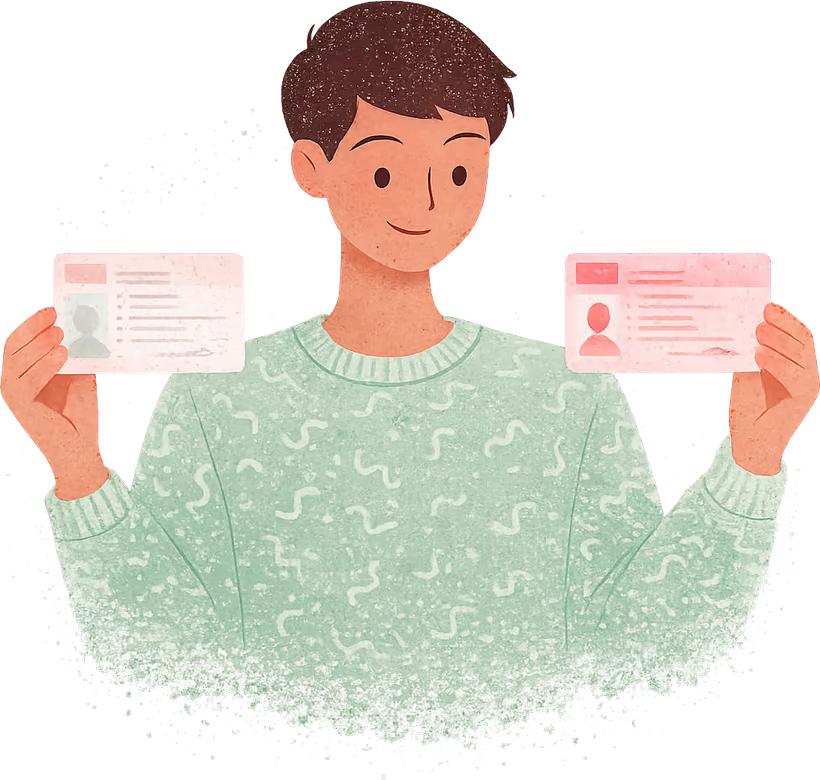
DVLA’s leaflet INS57P, Information on driving licences, takes the driver number apart: letters from your surname, digits from your date of birth, your initials, then check digits from DVLA’s computer. GOV.UK takes the change for granted too. Change your name after booking a driving or theory test, arrive without proof of it, and it says to book again in your new name “using your new driving licence number”.
DVLA’s leaflet labels the parts A to E. Here they are on an invented number for Robin Avery Sample, a man born on 22 September 1987. In DVLA’s own example the driver number runs to 16 characters, with the issue number printed after it.
Type the name on your licence now, then the name you are changing to. The comparison follows the rules in DVLA’s leaflet, part by part, and says plainly where the leaflet runs out.
Two worked examples, one for a new surname and one for new first names:
Robin Avery Sample becomes Robin Avery Fox
| Part | Now | New |
|---|---|---|
| A, surname | SAMPL | FOX99 Changes |
| B, date of birth | The same six digits | |
| C, initials | RA | RA Stays |
| D, check digits | Set by DVLA | |
Sam Lee becomes Alex Jordan Lee
| Part | Now | New |
|---|---|---|
| A, surname | LEE99 | LEE99 Stays |
| B, date of birth | The same six digits | |
| C, initials | S9 | AJ Changes |
| D, check digits | Set by DVLA | |
The card DVLA sends has the final word. This follows the leaflet’s rules and cannot see DVLA’s record.
Its rules fit in a few lines, and some names raise questions those lines leave open. We found nothing further from DVLA on any of them, so in each case the number printed on your new card is the one to go by.
The leaflet speaks only of letters, so the comparison above skips anything that is not one. Whether DVLA skips them too, it does not say.
A prefix could be kept as written, spelt out or shortened on DVLA’s record. The leaflet is silent, so the comparison uses your letters exactly as typed.
Accents are not mentioned at all. The comparison reads É as E and ö as O, which may or may not be what DVLA prints.
It could give one initial or two. The leaflet says only “the first 2 initials of your first names”, and the comparison takes one.
Someone known by one name, with no separate first name and surname, falls outside the leaflet’s rules, which assume both.
The leaflet adds 5 to the month for a woman, but does not say what happens to that digit when the gender on a licence changes. The comparison leaves the date part alone.
Anything that finds your licence by its number needs the one on your new card. Start with these, once the card is in your hands.
GOV.UK’s service makes a check code to share your driving record, and whoever checks it types in the code with the last 8 characters of your licence number. A code lasts 21 days and works only once, so make a fresh one after the new card comes.
It opens with three things: your driving licence number, your National Insurance number and the postcode on your licence.
Take proof of the new name to the test, such as your Deed Poll. Without it, GOV.UK says to cancel and book again with the new name and number. Tests and a new name.
A driving job may check your record the same way, with a code from you and those last 8 characters. nidirect lists employers beside car hire firms among the people a code is given to.
If your policy records your licence number, give the insurer the new one when the card arrives, and tell it about the new name in any case. Your car after a name change.
DVSA’s service for your Driver CPC training hours asks for your driving licence number. CPC and tachograph cards with a new name.
A new number does not mean a new start. Section 99 of the Road Traffic Act 1988, the part of the law behind a change of name on a licence, calls the card you get a replacement.
Your record and the vehicles you can drive. Neither the leaflet, GOV.UK’s name change guide nor section 99 says a new name alters them. To see both for yourself, sign in to the view service with the number on your new card.
From section 99 of the Road Traffic Act 1988, GOV.UK’s name change guide and DVLA’s leaflet INS57P, checked October 2026.
A licence from the Driver & Vehicle Agency is numbered another way. nidirect calls it an “eight digit driver number”, and its checking service asks for “the eight characters” of it, so it carries no letters from your surname or initials.
nidirect does not say whether a new name brings a new number, so look at the card the DVA sends back. The change itself goes on form DL1, by post, because the DVA cannot take a new name online. Form DL1, and where it goes.
From DVLA’s leaflet INS57P and nidirect, checked October 2026.
Tell DVLA the new name and it does the rest, free. Form D1 from a Post Office goes to DVLA, Swansea, SA99 1BN with your licence and the original proof of the new name. A Deed Poll also needs one document showing the new name, or the number of a UK passport issued in it.
GOV.UK says you can keep driving while you wait, and a licence applied for by post usually arrives within 3 weeks. The full guide to changing your licence.
Still deciding whether you have to? When the law says you must tell DVLA.
The Adult Deed Poll
£18.50
Only if you take a new surname. The first five characters of the number come from your surname, so taking your spouse’s rewrites them on the licence DVLA sends after form D1. Keep your own surname and there is nothing on the licence to change. Compare your two names.
Yes. DVLA’s leaflet INS57P says the first five characters are the first 5 letters of your surname, and a shorter surname is made up with 9s, as in MAN99. Your first two initials appear later in the number.
The six digits after the surname are your date of birth: the first and last give the year, the second and third the month, and the fourth and fifth the day. For a woman, DVLA adds 5 to the first digit of the month, so October shows as 60. Every part, explained.
The surname part, if your surname changes, and the two initials, if your first names do. The date of birth digits stay the same. DVLA sets the check digits that follow, and its leaflet does not say whether a new name brings new ones.
A count of your licences. DVLA’s leaflet says it goes up by one with every licence issued and is not part of the driver number; in its example it is printed after the 16 characters of the driver number itself.
nidirect does not say. It describes a Northern Ireland licence as having an eight digit driver number, so nothing in it is taken from your name, unlike a DVLA number. Check the card the DVA sends back after your form DL1.
Something else? Ask a paralegal and we will answer, usually the same working day.
Apply online in about five minutes. A paralegal drafts your Deed Poll, every spelling is checked against your order, and it is posted the same working day, ready to go to DVLA with form D1.
Secure checkout · card, PayPal, Apple Pay, Google Pay and Klarna
just ordered a Deed Poll.
Verified order · Online Deed Polls